Surveying the gender divide: further insights from the I Belong student attitude survey

Findings from our student attitude survey show that students in schools taking part in I Belong are more likely to consider GCSE Computer Science than those in the national sample, with enjoyment and feeling able to succeed playing an important role.
The I Belong programme launched with the aim to inspire more girls into computer science. By supporting teachers to address the needs of each pupil, we’re working to achieve a space where all children feel that they belong in computing.
Since the launch, we’ve closely monitored student views on computer science. Thousands of secondary students across England have shared their thoughts. This has helped us gain valuable insight into the factors that influence GCSE subject choices.
Last year, we explored students’ views prior to the I Belong programme. This year, we build on that work by exploring key patterns in students’ attitudes following their school’s engagement in the programme.
Evaluating attitude change
This blog presents findings to our recent analysis of 1321 responses to the post- programme survey, collected between April 2024 and October 2025. Findings from the survey are compared to research by DfE in 2022 as a comparison group indicating more general attitudes to computing in the student population(1). We use the term percentage point in the blog, a percentage point is the numerical difference between two percentages. It is a useful measure of change or difference.
Increased consideration for GCSE Computer Science
Before and after the I Belong programme, we asked students in Years 7-9 about their intention to study GCSE computer science.
Students in schools who have completed I Belong show higher levels of consideration compared to national benchmarks, as shown in previous research by the Department for Education.
Consideration is 8 percentage points higher overall and 6 points higher among girls.
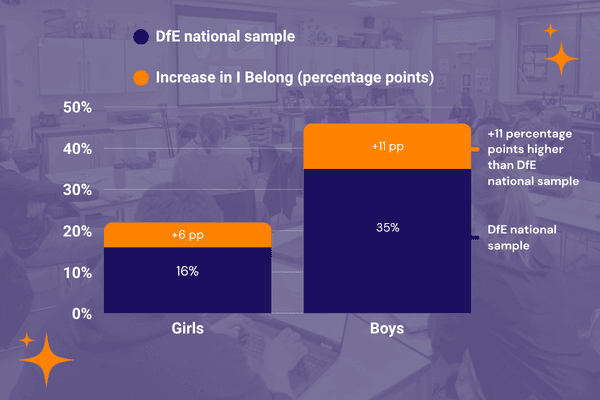
Improving attitudes towards computer science: the role of belonging and enjoyment
Students considering GCSE Computer Science report more positive attitudes towards the subject than those who are not considering it. The largest differences are seen in interest, sense of belonging, and enjoyment, highlighting the importance of positive classroom experiences in shaping subject choices.
Enjoyment emerges as a particularly influential factor, especially for girls. Girls who are considering the subject are much more likely to say they enjoy it (94%) than girls who are not considering it (47%). While the same pattern exists for boys, the difference is smaller (99% vs 62%).
This is particularly notable given that girls are typically less likely than boys to report enjoying STEM subjects more broadly, highlighting the importance of positive experiences in shaping their subject choices.
What motivates students to choose Computer Science?
Moving on to explore motivations amongst young people who intend to take GCSE Computer Science, reported motivations remain largely consistent with the findings reported in last year's blog. For both boys and girls, enjoyment of the subject (78% girls and 80% boys) and perceived value for future careers (62% boys and 60% girls) continue to be commonly selected reasons for choosing Computer Science at GCSE.
One notable gender difference in perceived capability among students who are considering Computer Science at GCSE. A higher percentage of boys (63%) selected feeling able to do Computer Science as a reason for choosing the subject than girls (49%).
This reflects wider findings from Department for Education research, which show that boys are more likely than girls to cite being good at Computer Science as a reason for choosing the subject. This highlights how important confidence is in shaping participation, and shows why it matters that teaching helps all students feel capable of success
Supporting inclusive computing classrooms
Taken together, these findings reinforce the importance of creating learning environments where all students feel they belong in computing. By fostering enjoyment, strengthening confidence, and highlighting the relevance of computing skills, schools can support more young people to consider Computer Science as part of their future.
This inclusive approach aligns with the Government’s vision set out in the Every Child Achieving and Thriving White Paper, which emphasises ensuring that every young person has the opportunity to succeed and thrive. Through professional development, high-quality teaching resources, and access to inspiring role models, the I Belong programme supports schools in building inclusive computing classrooms that help turn this vision into practice.
Key takeaways
- Higher GCSE Computer Science consideration among I Belong participants compared with the national sample (8 points higher overall; 6 points higher among girls)
- Students considering computer science report more positive attitudes, particularly in interest, sense of belonging, and enjoyment
- Enjoyment is a particularly important factor, especially for girls, with much higher levels among those considering Computer Science than those who are not
- Perceived capability plays an important role in subject choice, with 63% of boys and 49% of girls reporting that feeling able to do Computer Science influences their decision
Join the I Belong programme
Are these challenges familiar in your classroom? By joining the I Belong programme, schools can:
- Access real-time insights into students’ attitudes toward computer science.
- Identify specific barriers and motivators within their classrooms.
- Foster inclusive environments where all students feel they belong.
- Contribute to a national effort to improve participation in computing.
Start your journey today by enrolling in the I Belong programme.
(1) DfE regularly surveys parents, pupils and learners to gather evidence on issues relevant to policy, including attitudes towards computing. Questions on attitudes towards computing were included in both the Winter 2022 and Summer 2023 surveys. We have used the Winter 2022 survey as our baseline comparator because it predates the delivery of I Belong interventions and therefore provides the clearest benchmark against which to assess subsequent changes in attitudes towards computing.