Improving your school’s provision with the Computing Quality Framework
The vision of the National Centre for Computing Education (NCCE) is for every child in every school in England to have a world leading computing education.
We want to help schools develop exemplary computing provision, and the Computing Quality Framework (CQF) is the perfect tool to guide you to success. The CQF is a free and easy-to-use framework, which helps primary and secondary schools, trusts, and academies to raise the bar for computing education. With funding from the Department for Education, you can trust the CQF to guide you to success.
Identify strengths and areas for development within your school with our guided evaluation plan; our eight benchmarks are designed to define high-quality practice in essential areas.
Being able to provide an impactful computing education doesn’t have to be difficult.
Getting started
Once you’re registered with the CQF, you’ll be able to see your school’s review dashboard. Here, you can navigate between each benchmark, comparing your school’s assessed level against a national average. If starting the CQF process for the first time, you will be in a period of self-assessment; each benchmark requires an evidenced evaluation of your current stage, using prompt questions for justification.
When a start has been made on self-assessing, the review dashboard will provide an overview of the progress you make within the framework and acts as an easy visual cue for the benchmark areas which still require the most attention.
Our eight benchmarks cover all aspects of a high impactful computing education, such as Curriculum, Workforce development, and the most recent addition: Digital literacy & AI. Choose the relevant statements which best reflect your current position, adding commentary and evidence, while utilising your action plan for improvements and updating your statements as you progress.
Your school or academy shares one account for accessing the CQF, but there is no limit on how many users can be added. This allows for an interactive approach to improvement – work as a team to determine the best way to progress your provision.
Laura Cordon, Computing and STEM Lead at Hanley St Luke’s CofE Academy shared feedback on the CQF, praising the framework and related support as “making it manageable to collect evidence, reflect on practice, and celebrate achievements, ultimately helping schools deliver high-quality computing education for all pupils”.
Computing Quality Mark
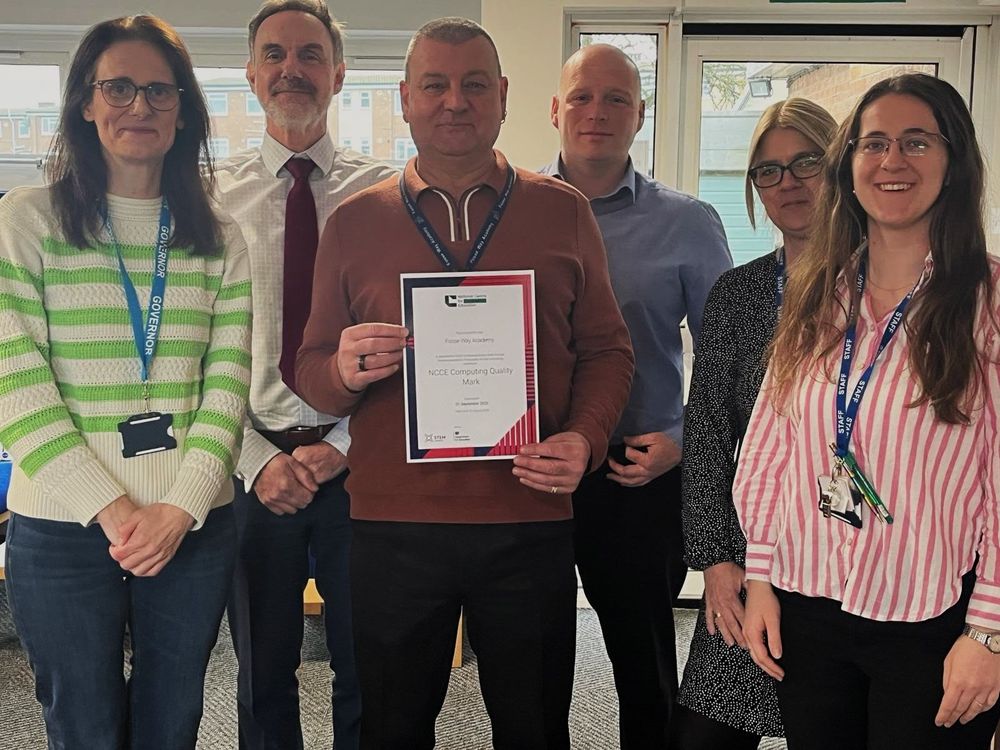
The CQF benchmarks are scored from levels 1 to 5. A score of 1 represents a lack of mastery, and a score of 5 represents complete best practice. If a school can demonstrate their computing provision is at a level 4 in all benchmarks, they are then able to apply for the Computing Quality Mark (CQM), an award to demonstrate the active approaches taken by teachers to better their school’s computing offer. The CQM award is valid for three years and can currently only be awarded to state-funded schools in England for free.
The best way to work towards this award is to engage with your action plan, combining the CQF-provided suggestions with resources and support from us. The NCCE offers over 130 professional development courses designed to help you teach computing. For each benchmark, there is a selection of recommended CPD to complete which supports you in evidencing your growth. This will lead you to improving your school’s computing provision and earning your CQM award.
If you need extra support in reviewing your current position or are looking for guidance on how to best improve, you can request a Subject Matter Expert (SME). The support our SME consultants offer affords state-funded schools and colleges in England additional assistance in better understanding their needs for growing your computing provision.
Digital literacy & Artificial Intelligence (AI)
In a rapidly advancing world, it’s important to be able to stay up to date with technology – especially when many students are accessing the latest tools without a formal understanding of how they work. Hena Shah of Trinity Academy Halifax states that the framework “ensures that our curriculum aligns with the latest advancements and prepares our students for future careers in computing”.
Digital literacy, including a focus on AI, is crucial to a comprehensive computing education. The newest CQF benchmark tackles this directly, addressing how well your school equips learners with digital literacy and ethical understanding required to thrive safely and responsibly in a digital world. Both teachers and students alike should be able to confidently navigate digital technologies, and we are here to support you in achieving this goal.
To learn more about how the CQF has affected teachers like you, check out the case studies listed here.
Get started with your review today. Let us help you to help your pupils grow with the CQF.