AI Awareness Day: Obed Nwachukwu, Educator and Data Professional
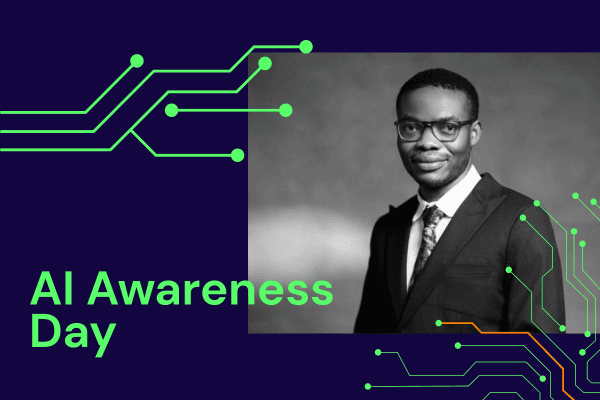
Artificial Intelligence has become part of my everyday workflow, both as an educator and as a data professional. While AI is often discussed in extremes - either as a revolutionary solution or as something to fear - my experience has been far more practical. I use AI as a tool to support productivity, creativity, and efficiency, but not as a replacement for human judgement or expertise.
In my technical work...
AI has been particularly useful for code debugging and refactoring. Sometimes, when working through complex scripts or data pipelines, AI tools assist me to quickly identify syntax issues, suggest cleaner approaches, or help optimise sections of code. It acts as an assistant that speeds up repetitive tasks, allowing me to focus more on problem-solving and architectural designs rather than spending unnecessary time troubleshooting minor errors.
AI has also helped me improve technical documentation. Producing clear and accessible documentation can be time-consuming, particularly when balancing technical detail with readability for different audiences. I often use AI tools to review technical drafts, helping refine structure, summarise complex information, and improve clarity, making the documentation easier to understand and more accessible to a wider range of users.
As an educator...
I have found AI valuable in supporting accessibility and inclusion. I use AI to review learning materials for accessibility compliance, helping identify areas where resources may be unclear, difficult to navigate, or not inclusive for all learners. This helps me create learning experiences that are easier to engage with and more supportive for diverse students.
At the same time, I think it is important to be realistic about what AI can and cannot do. Because of this, human oversight remains essential. There have been occasions where I have spotted errors, misleading outputs, or oversimplified responses generated by AI tools. Rather than accepting responses at face value, I regularly question outputs, refine prompts, and provide feedback to improve the quality of results. In many ways, using AI effectively requires critical thinking rather than less of it.
I also encourage people to avoid anthropomorphising AI systems. These tools are not conscious, emotional, or intelligent in the human sense, even if they sometimes appear conversational. Treating AI like a person can create unrealistic expectations and misunderstandings about its limitations.
For me, AI works best as a collaborative tool - one that enhances productivity and supports learning, while still relying on human judgement, creativity, and responsibility. As these technologies continue to evolve, developing AI literacy and critical thinking skills will become increasingly important across education and professional environments alike.
If you want to help students stay informed, gain future-ready skills and broaden their horizons, discover how we can support you on with resources on artificial intelligence here.