AI Awareness Day: Chidiebere Njoku, Data Scientist
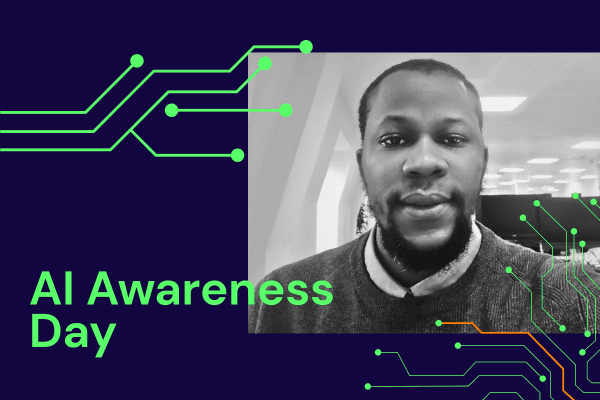
Chidiebere Njoku, Data Scientist for the Department for Education, discusses the uses of AI in his role in computing.
Artificial Intelligence (AI) is often associated with futuristic robots or chatbots, but many of its most impactful applications are happening quietly behind the scenes across industries such as education, healthcare, finance, and government. As an experienced Data Scientist working within the UK Department for Education (DfE), I have seen first-hand how AI is helping organisations make more informed, evidence-based decisions that can positively influence people’s lives.
In my role...
AI and machine learning are used to analyse large and complex datasets that would otherwise take significant time and resources to process manually. One area where this has been particularly valuable is in generating comparative school reports that improve attendance outcomes in the whole of England.
Using decision tree models and advanced analytics, I identify schools with similar characteristics and group them as “nearest neighbour” schools for comparison. These comparisons are based on factors such as Free School Meal (FSM) eligibility, geographic location, Special Educational Needs (SEN) profiles, school type, and pupil demographics. The system can generate reports comparing a school against approximately 20 statistically similar schools, helping education leaders and policymakers better understand performance patterns, contextual challenges, and areas for improvement.
AI-driven analytics are also helping improve attendance monitoring across primary and secondary schools in England. By analysing attendance data at scale, we can generate reports that compare current attendance trends with previous-year attendance and pre-pandemic attendance levels. This enables analysts and decision-makers to identify patterns, track recovery trends following COVID-19 disruptions, and detect schools or regions that may require additional support or intervention.
Beyond reporting, AI significantly improves efficiency. Tasks that previously required extensive manual analysis can now be automated, allowing teams to focus more on interpreting findings, communicating insights, and supporting strategic decision-making. However, while AI can process and analyse information rapidly, human expertise remains essential. Data scientists, analysts, policymakers, and education professionals are still needed to interpret results responsibly, understand context, and ensure fair and ethical use of technology.
Another growing area within the industry is Generative AI and Large Language Models (LLMs). These technologies are increasingly supporting activities such as summarising reports, improving documentation, analysing text-based feedback, and helping organisations manage knowledge more effectively. Like all AI systems, these tools must be used responsibly, with transparency, governance, and appropriate oversight.
One of the most important lessons I have learned while working in AI is that successful AI systems are not simply about technology they are about people, responsibility, and decision-making. AI should support human judgement rather than replace it.
AI Awareness Day provides an excellent opportunity to showcase the many practical and often unseen ways AI is being used across industries to solve real-world problems. It also highlights the importance of building AI literacy and digital skills so that individuals and organisations can engage with these technologies confidently, ethically, and responsibly as AI continues to evolve.
You can learn about more stories like Chidiebere's by requesting a Computing Ambassador to take part in an enrichment activity within your classroom. Help bring computing to life by requesting a STEM Ambassador today.